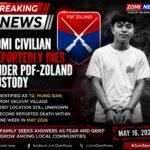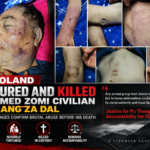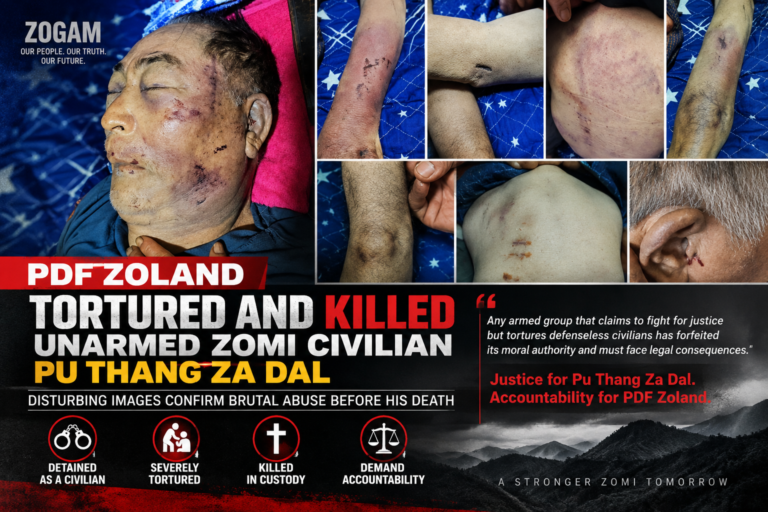
Reports that Pu Thang Za Dal was severely tortured before his death raise grave questions over the treatment of civilians in armed custody and demands for accountability.
ZOGAM — The reported torture and killing of Pu Thang Za Dal, an unarmed Zomi civilian, while in the custody of PDF Zoland represents a deeply disturbing case that demands an independent investigation and accountability.
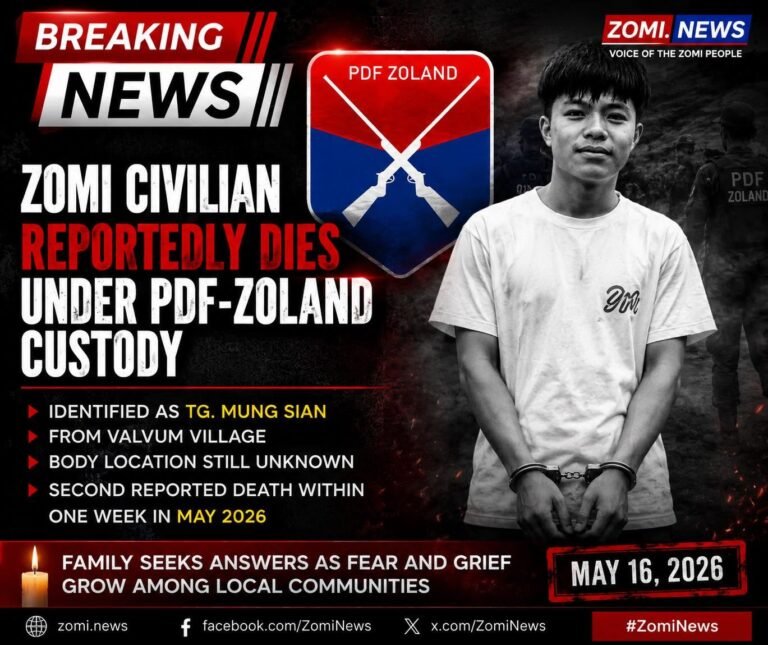
According to accounts circulated by local sources and members of the community, Pu Thang Za Dal — also referred to as Pu Dal — was detained before being killed. His body reportedly showed extensive injuries consistent with severe physical abuse.
Accounts surrounding his death allege that his captors subjected him to brutal treatment before he died. Reported injuries included damage to his mouth and teeth, mutilation of parts of his fingers, injuries around his neck, and numerous wounds across his body. One account further alleges that his tongue had been cut or severely mutilated.
The condition in which his body was reportedly returned has intensified demands from the community for a transparent investigation.
A Civilian in Custody, Not a Battlefield Casualty
The central issue cannot be obscured by the wider armed conflict.
Pu Thang Za Dal was reportedly an unarmed civilian being held in custody. If the accounts of torture and killing are substantiated, his death cannot reasonably be characterized as an ordinary battlefield casualty. It would instead raise grave questions concerning torture, cruel treatment, extrajudicial killing and the responsibilities of an armed organization toward persons under its control.
Political objectives or revolutionary claims do not provide immunity from fundamental standards of humane treatment.
An armed organization claiming to fight injustice cannot credibly demand justice from others while permitting torture, mutilation or the killing of defenseless people in its own custody. The legitimacy of any political or armed movement must also be measured by how it treats civilians, detainees and those who cannot defend themselves.
Accountability Must Apply to Every Armed Organization
The killing of Pu Thang Za Dal should not become another death buried beneath competing political narratives.
Those responsible for his detention, interrogation, treatment and death should be identified through a credible investigation. Command responsibility, the circumstances surrounding his detention, the cause of death and the actions of individual personnel should all be examined.
If evidence establishes criminal responsibility, those responsible should face appropriate legal accountability.
The same standard must apply regardless of political affiliation. Human rights cannot mean condemning abuses committed by an enemy while remaining silent when similar abuses are alleged against one’s own side.
For the Zomi community, this principle is especially important. Political disagreement must never become a license for Zomi lives to be treated as disposable. No civilian should be tortured, mutilated, or killed merely because of accusation, suspicion, personal hostility, or political disagreement.
The allegations surrounding Pu Thang Za Dal’s death are horrifying not merely because of their reported brutality, but because they confront society with a fundamental moral question: What separates a movement claiming to seek justice from the injustice it claims to oppose?
There can be no credible liberation built upon the torture of civilians. There can be no meaningful justice without accountability. And there can be no moral justification for cruelty against a defenseless person in custody.
Silence in the face of credible allegations of such abuse only deepens fear and impunity. Speaking against torture is not taking the side of one armed organization against another. It is taking the side of human dignity and the principle that every Zomi life has value.
Pu Thang Za Dal deserves more than expressions of grief. His family and community deserve the truth: who detained him, what happened while he was in custody, who authorized or carried out his treatment, how he died, and whether anyone will be held responsible.
Justice for Pu Thang Za Dal must mean truth, investigation and accountability — not revenge, collective punishment or another cycle of violence.
His death should stand as a warning to every armed organization operating in Zogam: no political cause places anyone above basic human dignity, and no uniform or revolutionary banner should shield those responsible for abuses against civilians.
Justice for Pu Thang Za Dal.
Accountability where the evidence leads.
Protection for Zomi civilians.
About The Author